It’s always a scary little thrill when a poem from a new project drops, so imagine my scare + thrill when Pithead Chapel (one of my favorite journals) published “Everyone Bowed Their Head and Prayed for God’s Blessing” in their latest issue (vol. 14, issue 8, August 2025). This prose poem is from my manuscript in progress, Latchkey. Thanks for taking a look!
I’m no stranger to writing about the 90s, particularly the cusp-of-millennium 90s, but doing it in flash fiction was something new. The Girl with the Black Lipstick is a book about a time and a place and a friendship that encompasses both the mundane and the transcendent. I started out thinking about the odd adventures people would have back when the internet didn’t overshadow us yet. The characters in this novella are as likely to have their noses in a book as they are to be strutting down a fashionable block in white denim booty shorts. (Fun fact–I had to go back and eliminate some of the white denim in this book, having subconsciously dressed my cast in so much that it seemed borderline cultish).
The hardest parts of this book project: sitting with all of the compiled flashes and deciding which to keep, proofing the typeset pages and finding all kinds of new connections (interesting ones, not just excess white denim), and cutting open the box to retrieve my first ever book of fiction (this was hard in a good way–so many emotions slicing open that tape).
As Sarah Freligh so kindly states, “This is a story that feels perfectly suited to the novella-in-flash, a reach back to grab the fragments of who we were in the final year of the twentieth century, to hold them to the light in an attempt to understand what peculiar threads connected us.”
A bit about the book: Against the backdrop of a boozy, restless late-90s Chicago, creative writing graduate student Mary Van Pelt and her eccentric roommate navigate the collision between party life, domestic harmony, and academic ambition in The Girl with the Black Lipstick. Mary Biddinger’s novella in linked flash stories conjures outrageous fashion and the oddest of odd jobs, sparing no detail when immersing readers in bedrooms, dancefloors, lakeshore beaches, and university seminars.
Photo by Satoki Nagata and cover design by Amy Freels.
Set before smartphones filled every pocket, The Girl with the Black Lipstick chronicles a bygone era of performance and spectacle. Biddinger offers vivid, surreal vignettes told in the heat of the moment or recalled as we follow Van Pelt from her first days of graduate school into life as a tenured professor. Our heroine and her roommate overcome predicaments and deepen their bond while simultaneously ignoring and obsessing over the future, blissfully unaware of challenges ahead until those challenges arrive. The Girl with the Black Lipstick is a tale of deep creativity and found family, paying tribute to those who support our youthful selves in unexpected ways.
I always love a book birthday, and this past spring we celebrated one year of A Mollusk Without a Shell: Essays on Self-Care for Writers (University of Akron Press, 2024). It’s been wonderful hearing how this book has been a help for writers of various backgrounds and experience levels, as well as for artists working in other genres. When the first box of books arrived at the University of Akron Press office I had to text co-editor Julie Brooks Barbour right away, as it felt odd to be unboxing without her. Thanks to everyone who has read this book, given it as a gift to a friend, shared it with a student, or dropped us a line of gratitude. Also, major thanks to Rhye Pirie for the gorgeous artwork on the cover!
Before 2023 ends I wanted to share some newly published poems, as well as this photo of grasses on campus, which startled me with their texture (you can’t hear them in the photo, but trust me, their woosh was a delight).
I’m honored to have two prose poems appearing in the new issue of Under a Warm Green Linden, with such brilliant company (including Diane Seuss, James Allen Hall, Jennifer Militello, and so many other stars). I’m tempted to use this issue as a free textbook for my upcoming advanced undergrad workshop–what a collection of poems under one roof. Big thanks to guest editor Simeon Berry.
Recent dream come true moment: a poem published in HAD, “Everyone Rise, the Gavel’s Coming Down.” Gratitude to Evan Nicholls, guest editor for this prose-poem-friendly submission period.
Most of my new year’s resolutions involve making more lists and getting organized, but I’ll add updating this blog to that batch of goals for 2024. In the meantime, happiest new year wishes to all!
Here’s the official book trailer for Department of Elegy, thanks to Upside Down Dog Productions.
Here’s the official Spotify soundtrack for Department of Elegy, too. At first I was going to try to make this all covers, but I would have to leave too many important cuts out, so it’s a mix. If possible, listen in order. Enjoy!
Much gratitude to West Trestle Review for including my flash fiction piece “Photos We Didn’t Take in 1998” in their new issue, with such excellent company. This issue also features encaustic art by Chizu Omori. Absolutely stunning!
This story is from my current project, a flash novella about the adventures of two (wild, gothy) grad school roommates in late-1990s Chicago.
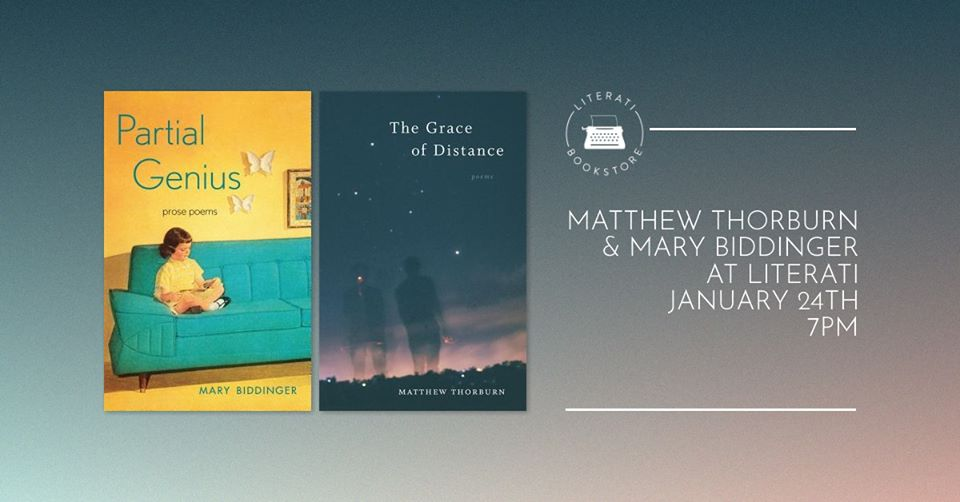
Every semester, on many different campuses, undergraduate students sit around a seminar table and discuss their poetry in a workshop setting. Sometimes they find not just competition, but allies and friends among those fellow poets, and occasionally those friendships last beyond the academic year, well past the submission of the final portfolio. Matthew Thorburn and Mary Biddinger have been friends since the early 1990s, when they were classmates in the creative writing sub-concentration at the University of Michigan. Little did these two young Michiganders know that decades later they would be mid-career poets with newly published collections, returning to their beloved Ann Arbor for a reading at Literati Bookstore. Rather than enumerating their old favorite coffee shops and best poetry readings of yesteryear, Mary and Matt had a conversation about their past and current projects, life as working poets, and what’s next for their writing careers.
MT: Mary, I’ve been a reader and admirer of your poems going all the way back to our undergrad days. Fast-forward to today and you’re the author of six books and a chapbook, including your latest book, Partial Genius. How do you keep going? How have you kept the practice of writing poems fresh and exciting over the years?
MB: Thank you so much for asking. I attribute much of my poetry energy to robust coffee consumption and feelings of being haunted. Thankfully, both of these commenced when I was an undergrad, if not before, so I may be riding a similar wave of dark roast into this new decade. Another aspect of poetry that’s enduring is a state of never quite having it figured out, and the exhilaration that ensues when realizing how much there is left to learn. I remember in our poetry workshops of yesteryear, how with every new round of poems there was an overwhelming sense of excitement that resonated beyond the task of discussing poems in an academic context. That has not changed for me over the years, and I hope it never fades.
MB: Matt, it’s a delight still being in touch after all of these years, and as I teach my own undergraduate poets I often think of those early experiences with poetry that made us connect so deeply with the craft. Looking back at your days as a beginning poet, is there any particular moment that stands out as being important to your choosing poetry as an art form?
MT: If there was one particular moment for me, it was the day I was flipping through our textbook in my 11th grade lit class—we were supposed to be reading Antigone—and found Lawrence Ferlinghetti’s “Fortune has its cookies to hand out…” and Allen Ginsberg’s “First Party at Ken Kesey’s with Hell’s Angels.” I’d read Dickinson and Frost and some W.C.W. the year before in American Lit, but these two poems—wow. That was it for me. I didn’t know poetry could do the things they did. Sixteen-year-old me was blown away.
My tastes and favorites have changed a lot in the years since then, but that was the day the door really opened for me. A few years ago I got to see Ferlinghetti at the 92nd Street Y in New York and he read that poem and others from his early books. “I still love reading these old chestnuts,” he said. I do too.
Mary, I’d like to shift gears a little here and ask you about your new book, Partial Genius, a collection of prose poems. Over the past year I’ve been mostly writing prose poems myself, so I’m curious to ask: What draws you to this form? And are there ways in which writing a prose poem is a different experience for you from writing a poem in lines?
MB: Among the other serious matters I pondered as an undergraduate, I grappled with the question of which genre would be my primary focus in creative writing. As someone who loves fiction and reads it not just for pleasure but for sustenance, I aspired to end up a short story writer, if not a novelist. However, life demands and limited attention span kept me solely in the terrain of the poem, the prose poem, and the short short story, and these pieces have increasingly found their way into my repertoire over the years.
I let the poems of Partial Genius take the lead when working on the project. Did I set out to write a book about France, relationship disappointments, industrial dance music, and being a college student? Not in the least, but these things kept bubbling up and I let them. I’m currently working on two book projects at once, and one of those two is another volume of prose poems. The new book focuses on a pair of graduate school roommates and their adventures in the late 90s. The prose poems are not written in four or five stanzagraphs, as in Partial Genius, but in larger blocks. I had a similar experience of feeling like they were very rewarding and kind of easy to write, rather than the “passing gallstones” experience of composing a traditional lineated poem.
MB: Many of my students are thinking about careers beyond the academy, and I wondered what advice you might have for poets working outside a university setting. I’m very jealous of the idea of leaving one’s work at work, and being free from stacks of grading and constant prep work. How would you advise writers who are starting out as poets and as professionals in a different discipline? Where might they look for literary community?
MT: Mary, it’s funny you ask that because many days I find myself envying my friends who teach at universities and wishing I worked in your world! But over the years I’ve found that working as a writer and editor in the corporate world complements my poem-writing life—providing financial stability and a regular schedule. As you said, most days when 5:30 rolls around I do get to leave my work at work. I recommend it as a way to earn your living as a writer, especially if you don’t feel a calling to teach.
I got started on this path through several internships—both on campus and then at a public relations agency—and that’s a good way to try it out and see if this works for you. I was surprised back then (and it’s still true today) how much demand there is for people who can write good sentences and tell stories in an engaging way on the page. The fundamentals of marketing writing and creative writing aren’t so different.
But I do think this path can make it harder to create and maintain a sense of literary community—and there can be a sense of being on the outside looking in. However, I’ve kept in touch with a few friends from my MFA program and my undergrad days (like you!), as well as extended my own literary community through conferences and writing book reviews and interviewing writers. On the flip side, that sense of being a bit outside of the poetry world can be a relief at times, and probably helps me just hunker down and write.
Speaking of careers, I wanted to ask about your work as an editor—and your experiences working with editors. You’ve published several collections now with Black Lawrence Press, including Partial Genius. You’ve also edited the Akron Series in Poetry for more than a decade, shepherding many wonderful books into the world. Thinking about your experiences on both sides of the table, what do you see as the key ingredients for an effective author-editor relationship?
MB: This is a great question to ponder! I think that being an editor makes a poet even more choosy about the handling of their own publications, so I got really lucky when finding Black Lawrence Press, a publisher with both aesthetic compatibility with my work and the kind of attentive support that I like to give our authors at the University of Akron Press. BLP publishes many more books than we do at the UAP, but they still do so much to shepherd each collection from manuscript to reality.
In terms of key ingredients for the ideal author-editor relationship, I would say that communication is quite important. Both at BLP and UAP there are different staff members who handle certain aspects of the process, so poets should make note of the best place to send particular queries for the most efficient response. Additionally, some poets need more help than others, especially when bringing a first book into the world, so I would recommend sending clear and specific questions to the editor, which makes it a lot easier to provide helpful answers. Rather than asking, “Does this book need something extra,” a poet might say, “I’m wondering if I should reverse the order of the penultimate poem and the final poem in the first section. What are your thoughts on this?”
MB: Matt, thinking about past work, I wondered if you ever return to older poems (perhaps even poems from undergrad days) and try to re-enter their world. Or do you leave past work in the past instead? If you do look back at older work, was there anything about your early efforts that surprised you? I was kind of amazed by some of the risks I took as an undergrad poet, for example. That girl was pretty bold.
MT: It’s funny you should ask that because my new book, The Grace of Distance, actually includes a handful of “older” poems—including one I wrote as an undergrad (!) and one from grad school. This book grew out of a folder I kept adding poems to over the years, as I put previous books together. This was my “b-sides” folder, a growing collection of poems I liked and felt were very good poems, but that just didn’t fit into those books for thematic reasons. Eventually I reread them and realized they didn’t fit in those books mainly because they were all about their own theme, exploring different ideas of faith (finding it, losing it, wondering what it is in today’s world). Recognizing that common thread helped guide me as I wrote the more recent poems that make up most of that book.
Looking back at my earlier books, I guess I’m interested and maybe a little surprised to see how much my first two books are about wordplay and working with sound almost as much as meaning. And in that sense some of the poems feel riskier to me too. Since then I’ve gravitated more toward narrative in my work.
Having talked about early work, can we wrap up with a sneak peek at our current projects? I’m working on two new projects that are formally very different from one another. The first is a book-length sequence of poems written in the voice of a teenage boy, about his experiences in a time of war and its aftermath. In these poems I do something new for me: write without punctuation. This is a formal practice I was skeptical of for years, until I read Leslie Harrison’s The Book of Endings. Leslie’s work completely changed my outlook and helped me find a way into this subject I had been thinking about. The other project, as I mentioned earlier, is writing prose poems, which I’ve been doing for a solid year now. I’m starting to sense the faint outlines of a book here too, as I keep returning to certain themes and stories, but I’m trying to take it poem by poem and just see how it unfolds.
What are you working on now?
MB: Those both sound like cool current projects, Matt, and thank you for asking about what’s in the works. For the first time, I myself have two manuscripts in progress at once. I do not recommend it, though it sounds like you are in a similar situation. I have one project about a pair of roommates and their adventures in grad school in Chicago in the late 1990s. I have another project comprised of smaller poems about ordinary things (or at least that’s how I am describing it right now). Both of these projects are 50+ pages long, and I’m still adding to them. Contrary to the way that I’ve worked in the past, I am now making an effort to take my time with these manuscripts. I’m thinking the roommates book (tentatively titled Apartment 1006) will be the first one finished, but who knows what the new year will bring.
Mary Biddinger’s poems have recently appeared in Psaltery & Lyre (“God’s Plan”) and Black Fork Review (three poems).
Matthew Thorburn’s poems have recently appeared on Verse Daily (“The Stag”) and New Limestone Review (two poems).
Mary Biddinger’s latest book of poems is Partial Genius(Black Lawrence Press, 2019). She teaches at The University of Akron and NEOMFA program, and edits the Akron Series in Poetry for The University of Akron Press. Poems have recently appeared in Court Green, Poetry,Tupelo Quarterly, and Waxwing, among others. She lives in a west Akron bungalow in a household of two adults, two teenagers, two dogs, and four cats.
Matthew Thorburn’s latest book of poems is The Grace of Distance (Louisiana State University Press, 2019). He’s also the author of six previous collections, including the book-length poem Dear Almost, which received the Lascaux Prize,and the chapbook A Green River in Spring. He works in corporate communications in New York City and lives with his wife and son in small-town New Jersey.
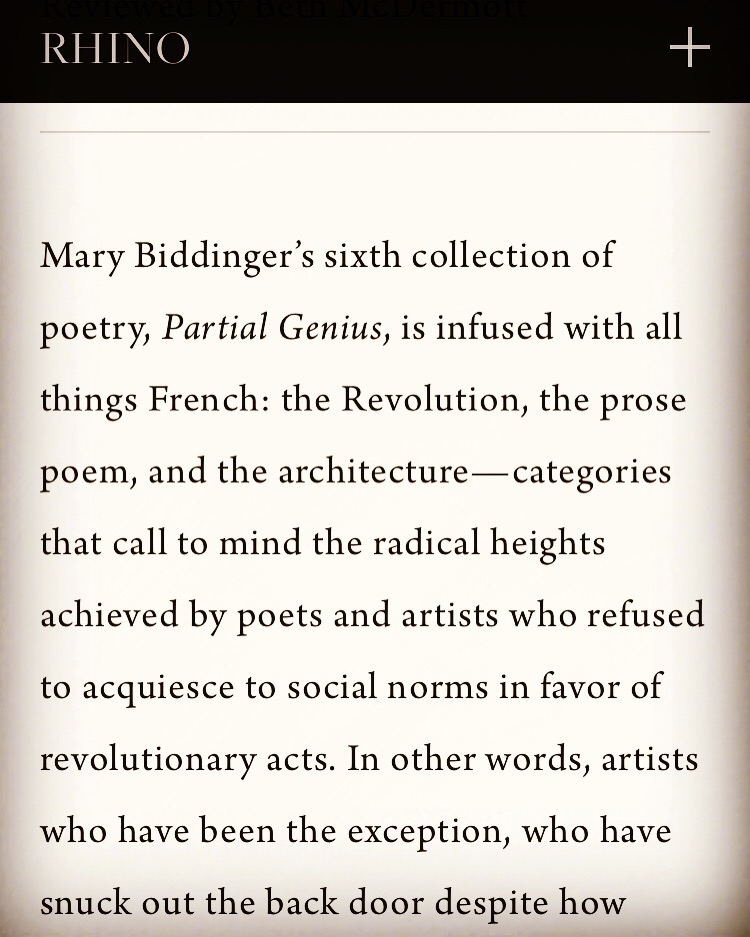
Once in a while a review helps you understand your own book better, and that is the case for Beth McDermott’s review of Partial Genius for RHINO. I am so grateful for Beth’s insights, and know that I will return to this review in the future when needing encouragement. For a minute I wondered, would it be weird to print out a review and frame it? I may just have to do that with this one.
In case you missed it a few weeks back, here’s my poem “Odd Mysteries” over at Psaltery & Lyre. What an honor to be paired with such a gorgeous photo that matches the poem’s feel and content! Thanks in advance for taking a look.



 Mary Biddinger